
Commercial Waterproofing in Florida: Why Your Building Needs It Every 8–10 Years
If you own or manage a commercial building in Orlando or anywhere in Florida, the question isn't whether water will try to get in, it's when. Florida's climate is one of the toughest environments in the country for commercial structures: relentless UV, daily humidity, hurricane-driven rain, and salt air all attack your building year-round. The single most cost-effective way to protect that investment is a planned program of commercial waterproofing, protective coatings, and caulking. Here's why staying ahead of water intrusion today saves building owners a multiple in repair costs tomorrow.
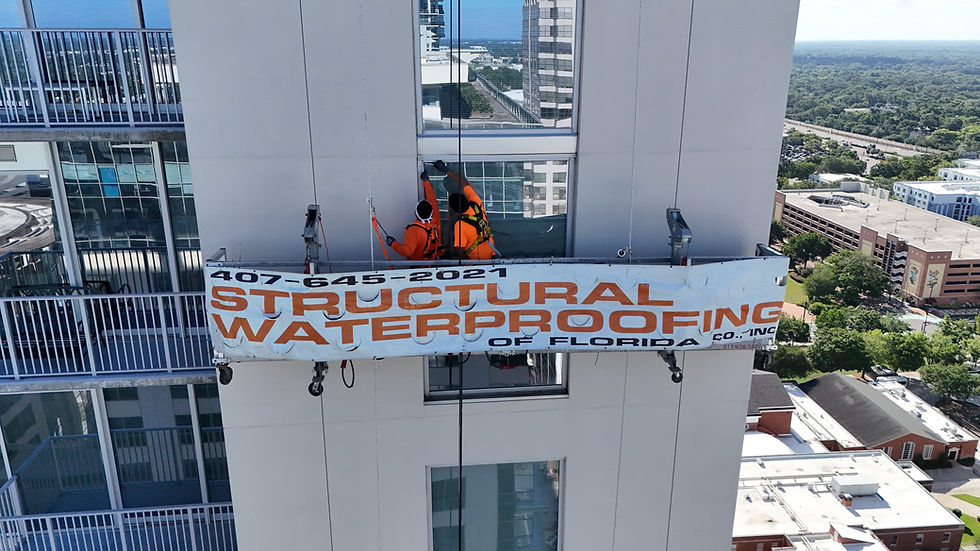
Why Commercial Waterproofing Matters in Florida
Water is the number-one enemy of any commercial building. Once moisture finds its way through a wall, parapet, balcony, or window perimeter, it doesn't stop. It rots wood, rusts steel rebar, breaks down stucco, ruins drywall, fuels mold growth, and quietly destroys the structural integrity of the building. By the time a property manager sees a stain on an interior ceiling, the damage behind the wall has usually been progressing for months, and sometimes even years.
In Florida specifically, the combination of intense sun, heavy seasonal rain, and hurricane exposure means commercial buildings deteriorate faster than in almost any other state. That's why a proactive waterproofing strategy isn't a luxury, it's basic asset protection.

Commercial Painting 
Glass-to-metal Window Caulking 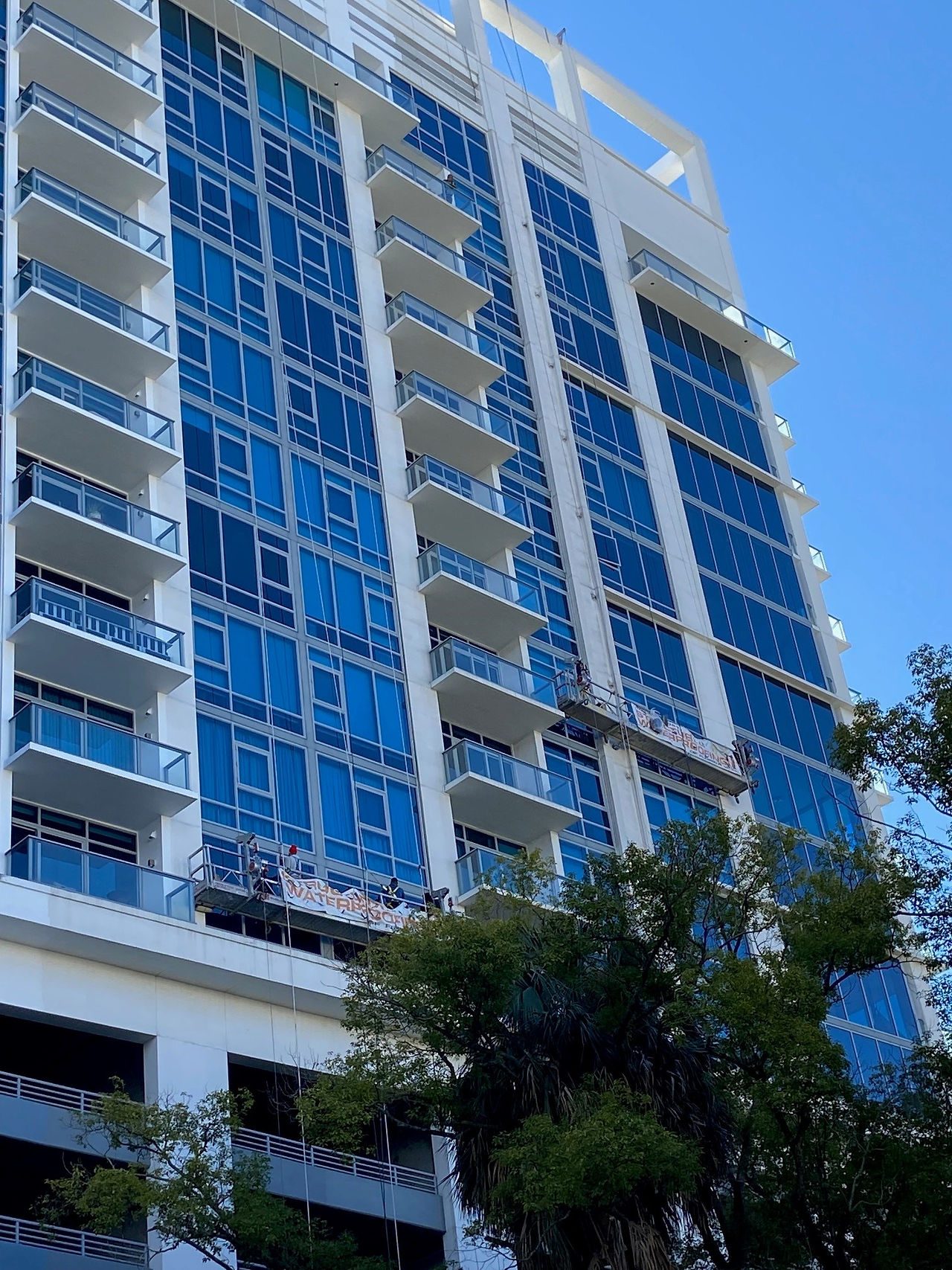
Commercial Waterproofing Orlando Florida
Every Commercial Building Needs a Fresh Protective Coating Every 8–10 Years
This is one of the most important things every commercial property owner should know:
a high-quality elastomeric or acrylic waterproof coating typically lasts 8 to 10 years before it needs to be reapplied.
That timeframe isn't arbitrary — it's almost exactly the warranty range you'll see from the major coating manufacturers. Most commercial-grade exterior coating warranties fall between 7 and 10 years, which tells you everything you need to know about a coating's effective service life. After that window, the coating begins to chalk, lose elasticity, and stop bridging hairline cracks in stucco, concrete, and masonry. When that happens, water finds a way in.
If your building's last paint and waterproofing job was 8 or more years ago, you are already living on borrowed time. Re-coating on schedule keeps your building under continuous protection and resets the clock — and the warranty — for another decade.
Spend a Little Today, Save a Multiple Tomorrow
Commercial owners sometimes hesitate to budget for waterproofing because the building looks fine. That's exactly the problem — by the time it doesn't look fine, you're no longer paying for waterproofing. You're paying for damage repair on top of waterproofing.
Here's how the math typically plays out on a Florida commercial property:
A scheduled exterior waterproofing and recoating project is a planned, budgeted line item — predictable in scope and cost.
A reactive water intrusion repair almost always involves stucco demolition, structural repairs, interior drywall replacement, mold remediation, tenant disruption, and emergency-rate labor.
Industry experience consistently shows that water-damage repairs cost three to ten times more than the preventative waterproofing project that would have stopped the leak in the first place.
Insurance carriers are increasingly excluding or limiting coverage for damage tied to deferred maintenance — meaning the longer you wait, the more of the bill lands on the owner.
Put simply: every dollar you spend on waterproofing today is buying you several dollars of
avoided repairs tomorrow.

Painting and Caulking Orlando 
Commercial Waterproofing Orlando Florida
Full Waterproofing Project (Before & After) - 332 North Magnolia, Orlando, FL
Water Intrusion: The Silent Threat to Every Commercial Building
Water intrusion rarely announces itself. It works through the smallest opening it can find — a hairline crack in stucco, a failed sealant joint around a window, a separation at a control joint, a pinhole in an old coating, or an unsealed penetration on a parapet wall. Once it's inside the wall assembly, it migrates wherever gravity and capillary action take it.
The most common entry points we see on Florida commercial buildings include:
Stucco cracks and delamination on exterior walls
Failed caulking and sealant joints around windows, doors, and storefronts
Expansion and control joints that have lost flexibility
Parapet walls, copings, and roof-to-wall transitions
Balcony decks, walkways, and stair landings
Through-wall penetrations like vents, conduit, and signage anchors
Each of these is a small problem on its own. Together, on a building that hasn't been recoated or re-caulked in a decade, they add up to a building that is no longer weather-tight.
Why Protective Coating AND Caulking Both Matter
Waterproofing a commercial building is a system, not a single product. The two halves of that system — protective coating (painting) and caulking (sealant joints) — only work when they're maintained together.
Protective coatings (typically elastomeric or high-performance acrylic) form a flexible, breathable membrane across the wall surface. They bridge hairline cracks, reflect UV, and shed bulk water. But coatings can't span the gaps where two different materials meet — that's where caulking takes over.
Caulking and sealants seal the joints around windows, doors, control joints, expansion joints, and dissimilar-material transitions. Sealants typically have a service life of 5 to 10 years depending on exposure, and they almost always fail before the surrounding coating does. A building can have brand-new paint and still leak like a sieve if its caulk joints have dried out, cracked, or pulled away from the substrate.
This is why a proper commercial waterproofing project always evaluates both the field of the wall and every joint, transition, and penetration on the building envelope.
Signs Your Commercial Building Is Due for Waterproofing
Walk your property and look for any of the following:
It has been 8 or more years since the last full exterior coating
Visible chalking, fading, or peeling on painted exterior surfaces
Hairline or stair-step cracks in stucco or block walls
Caulk joints that look hardened, cracked, separated, or missing
Water stains on interior ceilings or walls, especially after heavy rain
Efflorescence (white powdery deposits) on exterior walls
Rust streaks bleeding through stucco from embedded steel
Recurring tenant complaints about leaks, mildew smell, or humidity
Any one of these is a signal to get a professional inspection. Two or more, and waterproofing should already be in your next capital budget.

Cracked wall 
Delaminated Paint 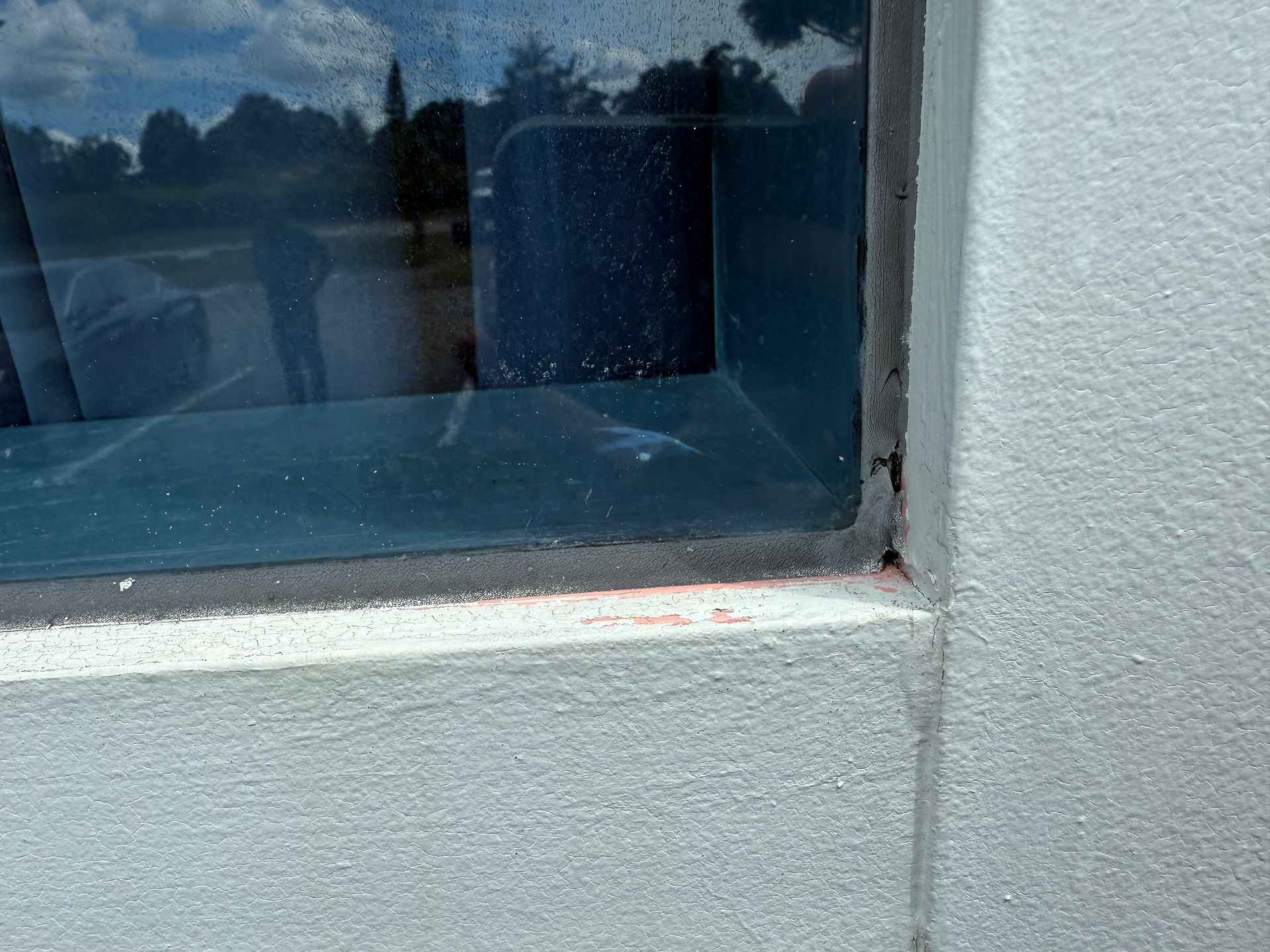
Failed Caulking 
Missing caulking 
Cracked facade 
Cracked caulking
Early signs of water intrusion
Protect Your Florida Commercial Building With Structural Waterproofing Co.
Structural Waterproofing Company is a commercial waterproofing, painting, and restoration contractor based in Florida and serving Orlando and the entire state. We work on condominiums, office buildings, mixed-use towers, hotels, retail centers, and HOAs across Florida — diagnosing water intrusion, restoring building envelopes, and applying long-life protective coating and caulking systems built for the Florida climate.
If your building is approaching the 8–10 year mark, or if you're already seeing any of the warning signs above, the most expensive thing you can do is wait. Schedule a no-cost building envelope evaluation with our team and get a clear, written scope of what your property actually needs.
Visit swpfl.com to request your commercial waterproofing evaluation today.

Comments